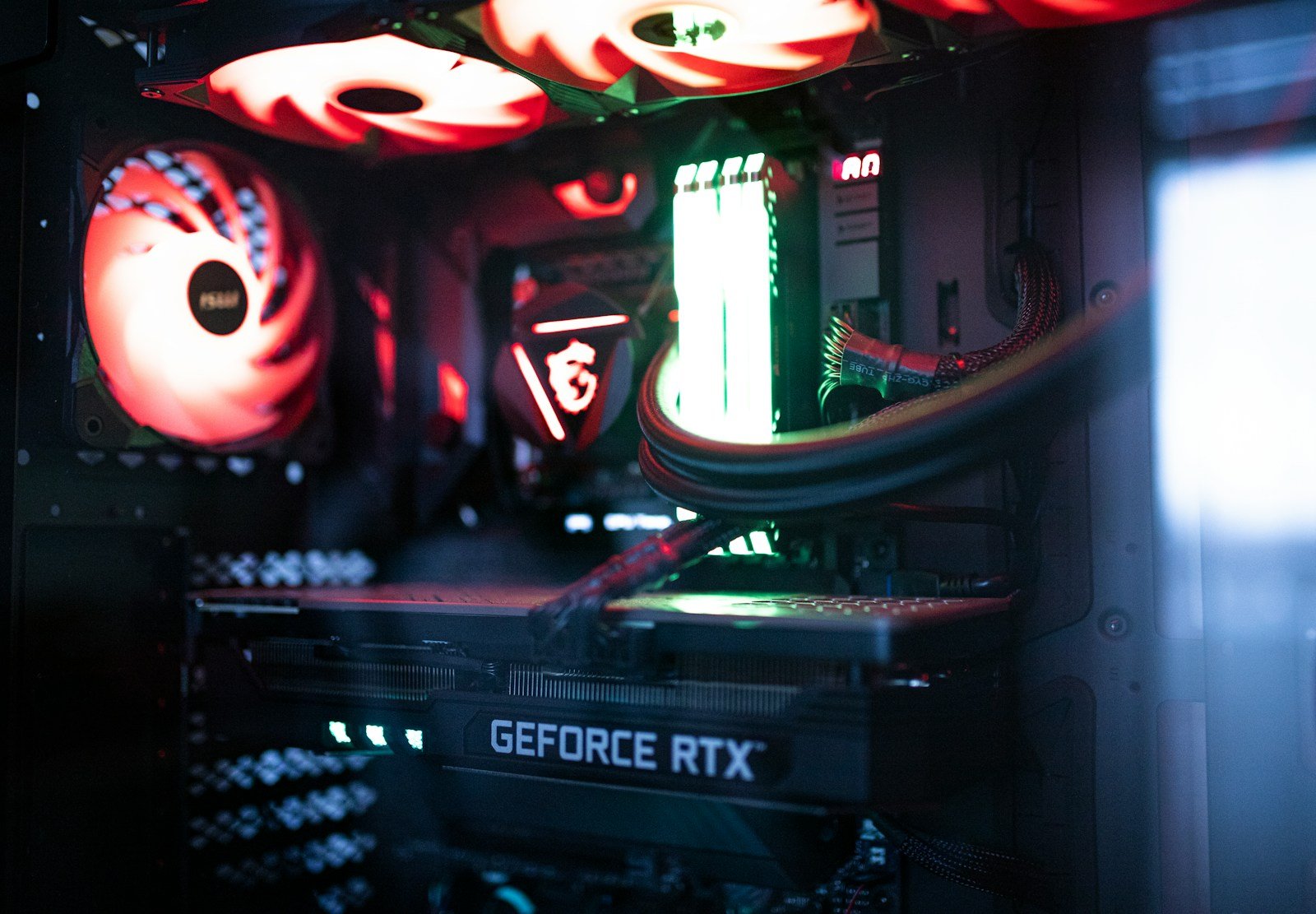
The NVIDIA GeForce RTX 3090 remains a powerful option for gamers and creators even in 2026. Released as part of the RTX 30 Series, this graphics card features the Ampere architecture with dedicated ray-tracing cores and Tensor Cores that deliver impressive performance for demanding tasks.
With 24GB of GDDR6X memory and a 384-bit memory interface, the RTX 3090 continues to handle 4K gaming and creative workloads with ease. Recent driver updates have further improved its capabilities, showing NVIDIA’s commitment to supporting their high-end cards years after release.
While newer generations have emerged, the RTX 3090 still offers excellent value for those seeking top-tier performance without investing in the latest hardware. Its TITAN-class performance and extensive memory make it relevant for users who need substantial graphics processing power for their projects.
How Does The NVIDIA GeForce RTX 3090 Perform In 2026?
The NVIDIA GeForce RTX 3090, launched in 2020 as part of the Ampere generation, was once the flagship powerhouse for gamers, creators, and AI enthusiasts. But how does this titan hold up in 2026, especially when compared to the newest RTX 5090 and 5080 models? Let’s dive into its current performance landscape and see where it stands.
Overview of the RTX 3090
At launch, the RTX 3090 was NVIDIA’s top-tier consumer GPU, featuring:
- 10,496 CUDA cores
- 24GB GDDR6X memory
- 350W power consumption
- Support for real-time ray tracing and DLSS 2.0
It excelled in 4K gaming, 3D rendering, and AI workloads, setting a high bar for performance.
RTX 3090 Performance in 2026
Despite its age, the RTX 3090 remains a capable GPU for many tasks:
- Gaming: It can still handle 4K gaming at high settings in most titles, though newer games with advanced ray tracing and AI features push it closer to its limits.
- Creative Workflows: For video editing, 3D modeling, and AI inference, the 3090’s 24GB VRAM is still valuable, especially for memory-intensive projects.
- AI and Machine Learning: While it supports AI workloads well, newer GPUs have significantly improved tensor cores and INT8 TOPS performance.
However, the RTX 3090’s architecture and driver optimizations are now several generations behind, affecting efficiency and raw performance compared to newer models.
Comparing to the RTX 5080 and RTX 5090
RTX 5080
- Performance: The RTX 5080 offers roughly 1.5 to 2 times the gaming and compute performance of the RTX 3090.
- Architecture: Built on the newer Ada Lovelace architecture, it benefits from improved power efficiency and advanced ray tracing cores.
- Memory: Typically equipped with 16-20GB of faster GDDR7 memory.
- AI: Enhanced tensor cores deliver significantly higher TOPS (trillions of operations per second), accelerating AI inference and creative workflows.
RTX 5090
- Performance: The RTX 5090 is the current flagship, outperforming the RTX 3090 by a factor of 3x or more in gaming benchmarks and AI tasks.
- Architecture: Uses the latest Ada Lovelace or beyond, with massive improvements in ray tracing, DLSS 3.5+, and power efficiency.
- Memory: Features 24GB+ of ultra-fast GDDR7 or newer memory.
- AI and Compute: Boasts cutting-edge tensor cores with over 3,300 INT8 TOPS, enabling lightning-fast AI inference and rendering.
Real-World Usage Scenarios
| Use Case | RTX 3090 (2026) | RTX 5080 | RTX 5090 |
|---|---|---|---|
| 4K Gaming | High settings, some compromises in newest titles | Ultra settings, smooth ray tracing | Max settings, ray tracing maxed out |
| 3D Rendering | Still strong, slower than newer GPUs | Faster render times, better efficiency | Industry-leading speed and quality |
| AI Inference | Good but limited by older tensor cores | 2-3x faster inference speeds | 5x+ faster, ideal for LLMs and AI workloads |
| Power Consumption | 350W, less efficient | ~300W, more efficient | ~350-400W, but much higher performance |
Should You Upgrade from the RTX 3090?
- If you’re gaming at 4K or below and satisfied with performance: The RTX 3090 remains a solid choice, especially if paired with a high-refresh-rate monitor.
- If you work with AI, content creation, or want future-proofing: Upgrading to the RTX 5080 or 5090 offers significant gains in speed, efficiency, and new features.
- Budget considerations: The RTX 5080 provides a sweet spot between price and performance, while the RTX 5090 targets enthusiasts who demand the best.
Conclusion
In 2026, the NVIDIA GeForce RTX 3090 is still a powerful GPU but shows its age compared to the cutting-edge RTX 5080 and 5090. For gamers and professionals seeking the latest features, improved efficiency, and superior AI capabilities, upgrading is worthwhile. However, the 3090 remains a capable card for many users, offering strong performance if you don’t require the absolute latest tech.
Key Takeaways
- The RTX 3090 features 24GB GDDR6X memory and Ampere architecture that still delivers excellent 4K gaming performance in 2026.
- Recent NVIDIA driver updates have improved performance and compatibility with newer systems.
- Despite being from an older generation, the card remains valuable for high-end gaming and creative professional workloads.
Technical Specifications and Performance
The NVIDIA GeForce RTX 3090 stands as one of the most powerful graphics cards in the RTX 30 series lineup. Built on advanced architecture and packed with cutting-edge features, this GPU delivers exceptional performance for demanding tasks.
GPU Architecture and CUDA Cores
The RTX 3090 is built on NVIDIA’s Ampere architecture using an 8nm manufacturing process. At its core, the GPU features the GA102 graphics processor in its GA102-300-A1 variant.
The card comes with an impressive 10,496 CUDA cores, providing massive parallel processing capability for gaming and professional workloads. These cores operate at boost clock speeds of up to 1.86 GHz in standard configuration, while some manufacturer-overclocked models push this even higher.
The RTX 3090 also includes dedicated 2nd generation RT Cores for ray tracing and 3rd generation Tensor Cores that power AI features like DLSS (Deep Learning Super Sampling). These specialized cores help deliver realistic lighting effects and improved performance through AI-enhanced upscaling.
Memory Configuration
One of the RTX 3090’s standout features is its massive 24GB of GDDR6X memory. This substantial amount of VRAM makes it ideal for professional applications, content creation, and high-resolution gaming.
The memory runs on a wide 384-bit bus and operates at speeds of 19.5 Gbps. This configuration delivers exceptional memory bandwidth, allowing the card to handle large textures and data sets with ease.
The generous memory allocation gives the RTX 3090 a significant advantage over other cards in the 30-series lineup, including the RTX 3080 which features 10GB of GDDR6X. This makes the 3090 particularly well-suited for 4K and 8K gaming as well as memory-intensive professional applications.
Power Requirements and Efficiency
The RTX 3090 is a power-hungry card with a TDP (Thermal Design Power) rating of approximately 350W, with the Ti variant pushing this even higher. This substantial power draw requires robust cooling solutions to maintain optimal performance.
Most RTX 3090 cards require at least an 850W power supply unit to function properly. The card typically uses a combination of 8-pin and 6-pin power connectors to draw the necessary power from the PSU.
Despite its high power consumption, the RTX 3090 delivers excellent performance-per-watt metrics compared to previous generations. The Ampere architecture brings significant efficiency improvements, allowing the card to deliver substantial performance gains while keeping power requirements manageable.
Features and Technologies
The NVIDIA GeForce RTX 3090 packs impressive hardware and cutting-edge technologies that set new standards in gaming and professional applications. Its architecture delivers exceptional performance through dedicated hardware components and software innovations.
NVIDIA DLSS and Ray Tracing
The RTX 3090 features dedicated 2nd generation RT Cores that enable realistic lighting, shadows, and reflections in games and applications. These specialized cores calculate how light rays interact with virtual environments in real-time, creating more immersive gaming experiences.
DLSS (Deep Learning Super Sampling) technology uses AI to boost frame rates while maintaining high image quality. The card’s 328 tensor cores power this feature, allowing games to run at higher resolutions without sacrificing performance.
Ray tracing combined with DLSS creates a powerful duo for gamers. The technologies work together to deliver realistic lighting effects while ensuring smooth gameplay even at demanding 4K resolutions.
NVIDIA Reflex complements these features by reducing system latency, giving competitive gamers faster response times and a competitive edge.
Enhancements for Gamers
The RTX 3090 comes with 24GB of GDDR6X memory on a 384-bit interface, providing ample capacity for texture-heavy games and future titles. This generous memory buffer prevents stuttering in games that use high-resolution textures.
G-SYNC technology eliminates screen tearing by synchronizing the display refresh rate with the GPU’s frame output. This creates smoother visuals without the input lag associated with traditional V-Sync.
GeForce Experience software simplifies driver updates and game optimization. The application automatically configures game settings based on the system’s hardware capabilities.
NVIDIA Broadcast enhances streaming quality with AI-powered features like noise removal and virtual backgrounds. Gamers can create professional-quality streams without expensive audio equipment.
Professional and Creative Solutions
Content creators benefit from the RTX 3090’s massive 24GB memory buffer when working with large video files or complex 3D models. This capacity allows professionals to handle resource-intensive projects without hitting memory limitations.
NVIDIA Studio drivers provide optimized performance for creative applications like Adobe Premiere Pro and Blender. These specialized drivers ensure stability and efficiency in professional workflows.
The card’s processing power accelerates AI operations and data science tasks. Its tensor cores enable faster training and inference for machine learning models.
For 3D artists, the RTX 3090 speeds up rendering times significantly compared to previous generations. Complex lighting calculations that once took hours can be completed in minutes.
Video editors experience smoother timelines when working with high-resolution footage, even when applying complex effects and color grading.
Frequently Asked Questions
The NVIDIA GeForce RTX 3090 remains a powerful graphics card with impressive specifications and capabilities. Many users have specific questions about its performance, pricing, and availability as of early 2025.
What are the current specifications of the GeForce RTX 3090 graphics card?
The NVIDIA GeForce RTX 3090 features 24GB of GDDR6X memory on a 384-bit memory interface. It contains 10,496 CUDA cores and operates at a base clock of 1.4 GHz with a boost clock of 1.7 GHz.
The card has a power draw of 350 watts and requires a minimum 750W power supply. It supports ray tracing with dedicated RT cores and includes DLSS technology for improved performance.
The RTX 3090 uses NVIDIA’s Ampere architecture and is built on Samsung’s 8nm process. It offers three DisplayPort 1.4a connections and one HDMI 2.1 port.
How does the RTX 3090’s performance compare to that of the RTX 4090?
The RTX 4090 outperforms the RTX 3090 by approximately 60-70% in most gaming benchmarks. This performance gap is due to the 4090’s newer Ada Lovelace architecture and higher CUDA core count.
In ray-tracing scenarios, the difference becomes even more pronounced with the 4090 sometimes doubling the 3090’s performance. The 4090 also features more efficient power management despite its higher TDP.
For AI and content creation workloads, the 4090 offers significant advantages with its improved Tensor cores. However, the 3090 still provides excellent performance for many professional applications.
What is the current market price for the NVIDIA GeForce RTX 3090?
As of March 2025, the RTX 3090 typically sells for $700-900 on the secondary market. New units have become increasingly rare as production shifted to newer models.
During special sales events, prices may drop below $700 for used models. Certified refurbished cards from authorized retailers generally command a premium of around $100-150 above used prices.
The card has seen significant price depreciation from its original MSRP of $1,499, making it more accessible to enthusiasts seeking high-end graphics capabilities.
Are there any recently announced upgrades or improvements to the RTX 3090 series?
No official hardware upgrades have been announced for the RTX 3090 as NVIDIA has moved on to newer generations. However, driver updates continue to optimize performance for new game releases.
The latest GeForce driver package includes specific optimizations for the RTX 3090 that improve compatibility with current software. These updates have addressed previous stability issues mentioned in user forums.
DLSS technology updates have also benefited 3090 owners, with the newest implementations providing better image quality and performance.
Where can one find the GeForce RTX 3090 available for sale?
The RTX 3090 is primarily available through secondary marketplaces like eBay and hardware swap forums. Some computer hardware retailers occasionally stock open-box or refurbished units.
Online computer component retailers may have limited new stock at premium prices. Specialty computer stores sometimes carry used models with limited warranties.
Buyers should verify the card’s condition and mining history before purchase. Cards used extensively for cryptocurrency mining may have reduced lifespans or performance issues.
How much video memory does the RTX 3090 have, and how does it impact gaming performance?
The RTX 3090 comes with 24GB of GDDR6X memory, which exceeds the requirements of most current games. This large frame buffer allows for gaming at 4K and even 8K resolutions with high texture settings.
The generous memory allocation particularly benefits content creators working with large video files or 3D models. For gaming, it ensures smooth performance even with heavy texture mods or at ultra-high resolutions.
Games optimized for ray tracing utilize this memory for storing additional lighting information. The extra VRAM also provides future-proofing as games continue to demand more graphics memory.