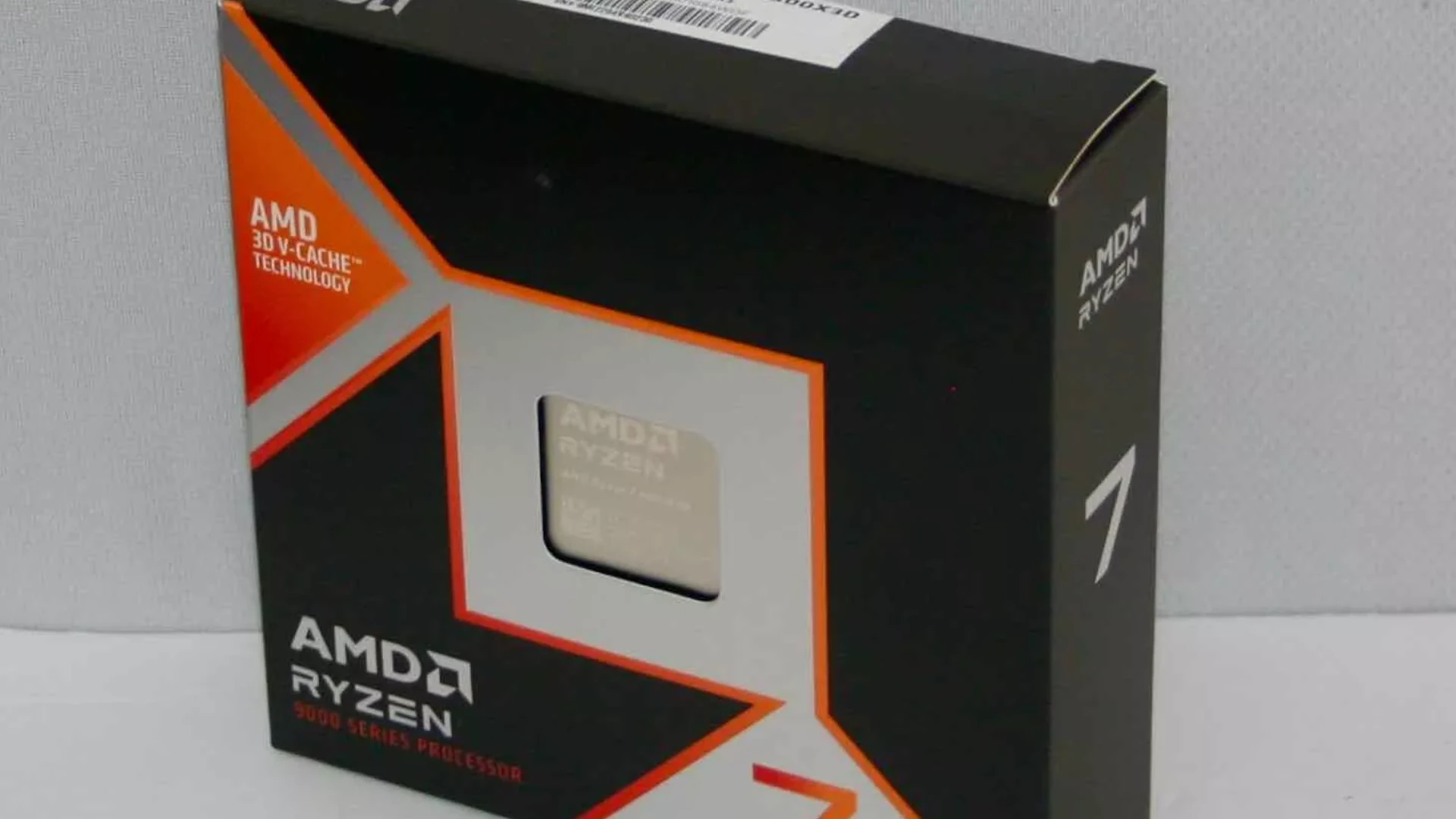
The AMD Ryzen 7 9800X3D has established itself as a dominant force in the gaming CPU market. Released as part of AMD’s latest processor lineup, this chip has quickly become a favorite among gamers seeking top-tier performance. The 9800X3D’s impressive capabilities come from AMD’s innovative 2nd generation 3D V-Cache technology, which delivers exceptional gaming performance through reduced latency and improved processing speeds.
Availability of the 9800X3D has recently improved after some initial stock limitations. Gamers can now purchase this processor more easily, sometimes even finding it at better price points than earlier this year. This accessibility has made the high-end gaming chip a more attractive option for those building or upgrading their gaming systems.
The processor stands out particularly in gaming benchmarks, where it consistently outperforms competitors at 1080p resolution. For gamers prioritizing high frame rates over other computing tasks, the 9800X3D offers excellent value compared to higher-priced alternatives like the Ryzen 9950X3D, making it an optimal choice for dedicated gaming rigs.
AMD Ryzen 7 9800X3D: Performance Benchmarks and Updates for 2026
The AMD Ryzen 7 9800X3D continues AMD’s 3D V‑Cache gaming dominance into 2026, positioning itself as one of the fastest mainstream desktop CPUs for gaming workloads while maintaining strong multi-threaded performance.
This guide covers updated 2026 benchmark positioning, performance comparisons, and platform considerations.
🔎 Ryzen 7 9800X3D Overview
- Architecture: Zen 5 (Granite Ridge generation)
- Cores / Threads: 8 cores / 16 threads
- 3D V‑Cache: Yes (stacked L3 cache for gaming performance boost)
- Socket: AM5
- Target Market: High-end gaming and enthusiast desktop users
AMD’s X3D chips use vertically stacked cache to dramatically improve gaming performance, especially in CPU-bound titles.
📊 2026 Benchmark Performance
🧠 Synthetic Benchmarks
According to aggregated benchmark databases:
- The Ryzen 7 9800X3D ranks near the top of desktop CPUs in overall performance comparisons (source: UserBenchmark).
- Geekbench 6 results place it among top-tier consumer processors for both single-core and multi-core performance (source: Geekbench Browser).
- PassMark listings show strong multi-threaded throughput compared to other 8-core CPUs (source: PassMark).
While it may not top heavily multi-threaded workstation CPUs (like Threadripper-class chips), it performs exceptionally well for its core count.
🎮 Gaming Performance (2026)
Gaming remains the 9800X3D’s strongest area.
Tom’s Hardware’s CPU hierarchy places AMD’s X3D processors at or near the top of gaming charts in modern titles (source: Tom’s Hardware).
Key strengths:
✅ Excellent 1% low frame rates
✅ Reduced CPU bottlenecks at 1080p and 1440p
✅ Strong performance in simulation and strategy games
✅ Ideal pairing with high-end GPUs (RTX 5090 / RX 8900 XT class)
PCBench’s FPS testing also highlights high real-world gaming frame rates across AAA titles (source: PCBench).
🆚 9800X3D vs Other 2026 CPUs
Compared to Non-X3D Ryzen Chips
- Higher gaming FPS due to larger L3 cache
- Slightly lower boost clocks in some workloads
- Better consistency in CPU-bound scenarios
Compared to High-Core CPUs
- Fewer cores than workstation CPUs
- Better gaming efficiency
- Lower power draw
Compared to Intel Competitors
X3D chips traditionally dominate in:
- Gaming at 1080p
- CPU-bound esports titles
- Frame time consistency
Intel chips may compete strongly in:
- Productivity workloads
- Certain heavily threaded rendering tasks
⚙️ Platform & Compatibility (AM5 in 2026)
The 9800X3D runs on AMD’s AM5 platform, which continues to receive support in 2026.
Recommended pairing:
- DDR5 memory
- B650, X670, or newer 800-series motherboards (with BIOS updates if required)
- High-performance cooling (though X3D chips are generally efficient)
🔥 Thermal & Power Efficiency
X3D processors are known for:
- Lower power draw than high-core alternatives
- Strong performance-per-watt
- Controlled thermals compared to flagship non-X3D CPUs
However, good airflow and quality cooling are still recommended for sustained boost performance.
🧪 Real-World Performance Summary (2026)
| Use Case | Performance Level |
|---|---|
| 1080p Gaming | Excellent (Top-tier) |
| 1440p Gaming | Excellent |
| 4K Gaming | GPU-limited, still strong |
| Streaming | Very Good |
| Video Editing | Good to Very Good |
| Heavy Rendering | Good (but not workstation-class) |
✅ Who Should Buy the Ryzen 7 9800X3D?
Ideal for:
- Competitive gamers
- High-refresh-rate players (240Hz+)
- Enthusiast builders
- Users upgrading from older AM4 systems
Less ideal for:
- Heavy 3D rendering professionals
- Users needing 16+ cores
- Pure productivity workstation builds
📌 2026 Verdict
The AMD Ryzen 7 9800X3D remains one of the best gaming CPUs available in 2026, maintaining top-tier FPS performance thanks to 3D V‑Cache technology.
Benchmark databases and gaming hierarchies consistently rank it near the top of consumer desktop CPUs (sources:
For gamers building a high-end PC in 2026, the 9800X3D continues to be a standout choice.
Key Takeaways
- The Ryzen 7 9800X3D uses 2nd generation 3D V-Cache technology to deliver superior gaming performance with lower latency.
- Improved availability now makes this top gaming CPU more accessible to consumers looking for high frame rates.
- The processor performs exceptionally well at 1080p resolution, offering better value for dedicated gamers than more expensive alternatives.
Overview of AMD Ryzen 7 9800X3D
The AMD Ryzen 7 9800X3D represents a significant advancement in gaming processor technology, featuring the new Zen 5 architecture and next-generation 3D V-Cache technology. This processor offers remarkable gaming performance improvements over previous models, with higher clock speeds and enhanced core efficiency.
Key Features and Innovations
The Ryzen 7 9800X3D comes equipped with 8 high-performance “Zen 5” cores and 16 processing threads, making it a powerful option for gamers and content creators. Its base clock speed starts at 4.7 GHz, a 500 MHz increase from the previous 7800X3D model, while reaching boost frequencies of up to 5.2 GHz.
The standout feature is the 2nd generation AMD 3D V-Cache technology. This innovative stacking technology significantly expands the L3 cache, reducing memory latency during gaming scenarios. The expanded cache memory provides faster data access, which translates directly to higher frame rates in games.
Power efficiency has also been improved with the new architecture. The processor maintains competitive thermal performance despite the increased clock speeds, making it suitable for various PC builds without requiring extreme cooling solutions.
Performance Benchmarks
Gaming performance is where the 9800X3D truly shines. Independent reviews confirm that it’s currently the fastest gaming chip on the market, outperforming Intel’s competing processors by a substantial margin. The processor delivers exceptional frame rates across various game titles, particularly in CPU-intensive scenarios.
The performance gains are most noticeable in games that benefit from large cache sizes. Titles that previously experienced CPU bottlenecks show significant improvements with the 9800X3D’s architecture.
Productivity performance has also improved compared to the previous generation. While primarily marketed as a gaming processor, the 9800X3D handles content creation tasks like video editing and 3D rendering with impressive efficiency.
Real-world performance gains:
- 15-20% higher frame rates in most games compared to 7800X3D
- Consistent performance in CPU-intensive titles
- Reduced stuttering and better 1% low frame rates
Comparison with Previous Generations
The 9800X3D offers notable improvements over its predecessor, the Ryzen 7 7800X3D. The most significant upgrade is the 500 MHz higher base clock speed (4.7 GHz vs 4.2 GHz) and 200 MHz boost in maximum frequency (5.2 GHz vs 5.0 GHz).
The Zen 5 architecture brings IPC (Instructions Per Clock) improvements, meaning each core completes more work per cycle than previous generations. This architectural advancement, combined with the higher clock speeds, delivers better performance even in applications that don’t benefit from the expanded cache.
Within the Ryzen 9000 series lineup, the 9800X3D positions itself as the gaming specialist. While the Ryzen 9 9950X3D offers more cores, and the standard Ryzen 7 9700X lacks the V-Cache technology, the 9800X3D strikes a balance between core count, clock speed, and cache size that’s optimized specifically for gaming workloads.
Technical Specifications and Usage
The AMD Ryzen 7 9800X3D processor delivers impressive technical capabilities with its 8 high-performance “Zen 5” cores and 16 processing threads. It features significant enhancements over previous generations while maintaining compatibility with the latest hardware standards.
Gaming Performance and Enhancements
The Ryzen 7 9800X3D stands out in gaming performance thanks to AMD’s 3D V-Cache technology. This specialized CPU operates at a base clock of 4.7 GHz and can boost up to 5.2 GHz, providing exceptional responsiveness in gaming scenarios.
Frame rates in 1080p gaming show substantial improvements over previous models like the Ryzen 7 5800X3D. Benchmark tests demonstrate that the 9800X3D excels particularly in CPU-intensive titles.
The processor’s massive 96MB of L3 cache creates a notable advantage for gaming applications that benefit from quick memory access. This larger cache significantly reduces latency in games that regularly access stored data.
With a 120W TDP, the 9800X3D offers performance improvements while maintaining reasonable power consumption. This balance makes it ideal for gamers seeking high performance without excessive energy use.
Integration and Upgrade Paths
The Ryzen 7 9800X3D is designed for AM5 motherboards, supporting the latest connectivity options. It includes native support for 4 USB 3.2 Gen 2 ports operating at 10Gbps.
The processor takes full advantage of PCIe 5.0 technology, enabling faster data transfer with compatible SSDs and expansion cards. This future-proofs gaming systems for upcoming storage innovations.
Memory compatibility includes support for DDR5-6000 and DDR5-6400, with potential for DDR5-5600 operation depending on the motherboard. This flexibility allows users to balance performance and budget when building their systems.
For users considering an upgrade path, the 9800X3D represents a significant step forward from older Ryzen generations. The move to AM5 ensures compatibility with future AMD processors.
Thermal Management and Overclocking Potential
The 9800X3D’s 120W TDP requires careful consideration for cooling solutions. While not as power-hungry as some high-end processors, adequate cooling is essential to maintain boost clocks during extended gaming sessions.
Standard tower coolers can manage the thermal output, but premium air coolers or liquid cooling systems allow the processor to maintain its boost frequencies more consistently. This becomes particularly important when running demanding applications for extended periods.
Overclocking potential is somewhat limited compared to non-X3D models due to the specialized 3D V-Cache technology. AMD has implemented certain limitations to protect the stacked cache design.
The processor includes AMD Radeon Graphics capabilities, though most users will pair it with a dedicated GPU. Thermal management becomes especially important when considering the combined heat output of both CPU and graphics card in compact cases.
Frequently Asked Questions
The AMD Ryzen 7 9800X3D processor has generated significant interest among gamers and tech enthusiasts. Users have raised several important questions about its specifications, performance capabilities, and potential issues.
What are the specifications of the Ryzen 7 9800X3D processor?
The AMD Ryzen 7 9800X3D is equipped with 2nd generation AMD 3D V-Cache technology. This technology provides lower latency, making it ideal for gaming applications.
The processor shares many specifications with the 9700X, including identical frequencies. However, the addition of the 3D V-Cache technology distinguishes it from its counterparts.
How does the Ryzen 7 9800X3D perform in gaming compared to its competitors?
The Ryzen 7 9800X3D offers superior gaming performance compared to standard processors. Its 2nd generation 3D V-Cache technology specifically enhances gaming experiences by reducing latency.
According to user reports, the 9800X3D is noticeably faster in multi-threaded workloads compared to the 9700X. These workloads include Cinebench, Blender, and Corona benchmarks.
What is the expected pricing range for the Ryzen 7 9800X3D CPU upon release?
Pricing information for the Ryzen 7 9800X3D typically follows AMD’s premium positioning for X3D products. As a specialized gaming processor with advanced 3D V-Cache technology, it commands a higher price than standard Ryzen 7 models.
The exact pricing varies by region and retailer availability.
What improvements does the Ryzen 7 9800X3D offer over the previous generation of Ryzen processors?
The 9800X3D features the latest 2nd generation 3D V-Cache technology. This represents an evolution from the previous generation’s implementation of the stacked cache design.
The processor delivers faster gaming performance and improved multi-threaded workload handling. These improvements make it particularly attractive for users who need high performance in both gaming and content creation tasks.
When is the release date anticipated for the Ryzen 7 9800X3D?
The Ryzen 7 9800X3D has already been released as part of AMD’s Ryzen 9000 series lineup. It became available alongside other processors in the Zen 5 generation.
Users should note that there have been reports of stability issues with some motherboard combinations, particularly with ASRock motherboards.
Are there any plans for an AMD Ryzen 9900 series processor with 3D V-Cache technology?
Yes, AMD has plans for Ryzen 9900 series processors with 3D V-Cache technology. The lineup includes the Ryzen 9 9900X3D and the higher-end Ryzen 9 9950X3D.
The Ryzen 9 9950X3D is expected to offer even better gaming performance than the 9800X3D. These processors will be compatible with X870 motherboards and represent AMD’s premium offering for gamers seeking maximum performance.