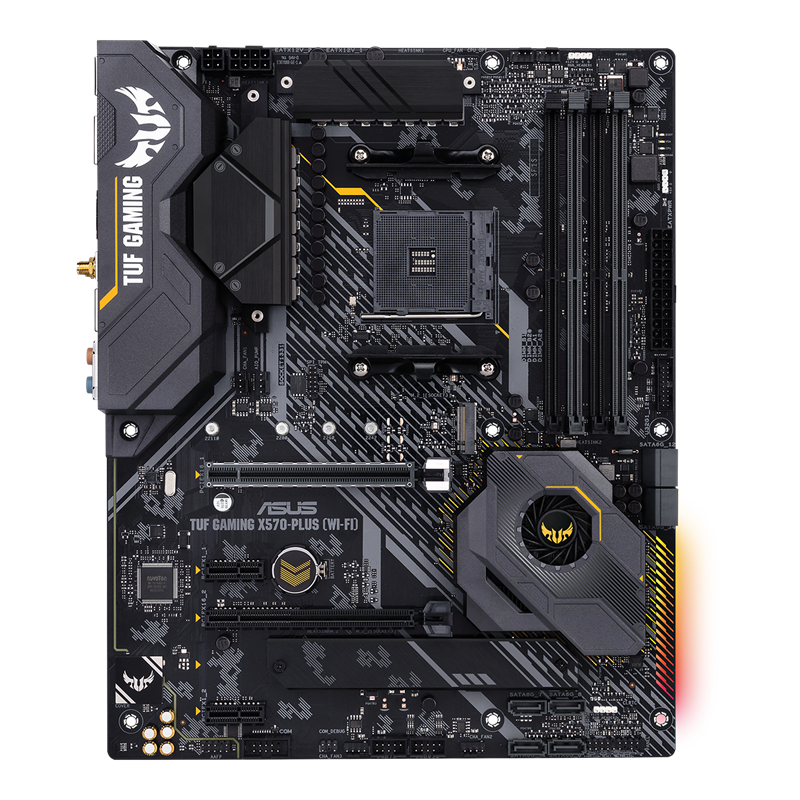
Looking for a high-performance motherboard for your gaming setup? The ASUS TUF Gaming X570-Plus (Wi-Fi) combines durability with impressive features that make it worth considering for your next build. This AMD AM4 ATX gaming motherboard offers PCIe 4.0 support, dual M.2 slots, and Wi-Fi 6 connectivity, creating a solid foundation for both current and future gaming needs.
The motherboard boasts a reliable VRM design with 14 DrMOS power stages that help ensure stable performance even during intensive gaming sessions. It also includes practical connectivity options with HDMI, DisplayPort, SATA 6Gb/s, and USB 3.2 Gen 2 ports. Gamers will appreciate the pristine audio with positional cues that enhance the experience, especially in first-person shooter games.
Beyond performance, the TUF Gaming X570-Plus offers aesthetic customization through Aura Sync RGB lighting that coordinates with compatible accessories. The attractive pricing makes this motherboard an excellent value proposition, especially considering its feature set and durable construction that lives up to the TUF (The Ultimate Force) branding.
TUF Gaming X570-Plus (Wi-Fi): Review For 2026
The ASUS TUF Gaming X570-Plus (Wi-Fi) has been on the market since 2019, making it a mature, budget-friendly option for AMD Ryzen builds in 2026. While newer chipsets like X670E have arrived, this motherboard still offers compelling value for specific use cases. This comprehensive review examines whether the X570-Plus remains relevant in 2026, who should consider it, and how it stacks up against modern alternatives.
Quick Verdict: Is It Still Worth It in 2026?
Best for:
- Budget builders using Ryzen 3000/5000 series CPUs
- Upgrades from older AM4 systems
- Secondary or office builds
- Users who need PCIe 4.0 without premium pricing
Skip if:
- Building with Ryzen 7000/9000 series (requires AM5 socket)
- Need PCIe 5.0 for latest GPUs and SSDs
- Want DDR5 memory support
- Planning a high-end, future-proof build
2026 Rating: 7/10 – Solid for budget AM4 builds, but showing age against modern standards.
Specifications Overview
Key Features
| Feature | Specification |
|---|---|
| Socket | AM4 (Ryzen 3000/5000 series) |
| Chipset | AMD X570 |
| Form Factor | ATX (12″ x 9.6″) |
| Memory | 4x DIMM, DDR4 up to 4400MHz+ (OC), 128GB max |
| Storage | 2x PCIe 4.0 M.2 slots, 8x SATA 6Gb/s |
| Expansion Slots | 1x PCIe 4.0 x16, 1x PCIe 4.0 x16 (x4 mode), 2x PCIe 4.0 x1 |
| USB Ports | 1x USB-C 3.2 Gen 2, 7x USB-A 3.2 Gen 2, 6x USB 2.0 |
| Networking | Intel I211-AT Gigabit LAN, Intel Wi-Fi 6 (802.11ax) |
| Audio | Realtek S1200A codec (7.1 surround) |
| Price (2019 Launch) | $189.99 MSRP |
| Price (2026 Used Market) | $80-$120 estimated |
(source: Tom’s Hardware)
What Makes It Special
Military-grade TUF components:
- TUF capacitors rated for extended durability
- TUF chokes for better power efficiency
- TUF MOSFETs for stable power delivery
- Designed for 24/7 operation and longevity
PCIe 4.0 support:
- Dual PCIe 4.0 M.2 slots for fast NVMe SSDs
- PCIe 4.0 graphics card support
- Significantly faster than PCIe 3.0 (still relevant in 2026)
Comprehensive cooling:
- Active chipset fan with dust-resistant bearing
- VRM heatsinks for stable CPU power delivery
- M.2 heatsinks to prevent SSD thermal throttling
- Multiple fan headers with PWM control
(source: ASUS Official)
Design and Build Quality
Aesthetics
The TUF Gaming X570-Plus features ASUS’s signature military-inspired aesthetic:
- Black and grey color scheme with yellow accents
- TUF Gaming logo with customizable RGB lighting
- Stealthy design that ages well (not overly gamer-y)
- Matte finish resists fingerprints and looks professional
In 2026, the design still holds up reasonably well. It lacks the RGB excess of some competitors, making it suitable for both gaming and professional environments.
Build Quality and Durability
Premium construction features:
PCB quality:
- 6-layer PCB for better signal integrity
- Military-grade TUF components throughout
- Reinforced PCIe slots to prevent GPU sag damage
- High-quality solder points for reliability
Thermal solution:
- Substantial VRM heatsinks with good contact
- Actively cooled X570 chipset (necessary due to chipset heat)
- M.2 heatsinks included for both slots
- Smart fan headers for customized cooling
After 5+ years on market:
- Reports of excellent long-term reliability
- Active chipset fan remains a potential failure point
- Most units from 2019-2020 still running strong in 2026
- TUF branding has proven to deliver on durability promise
(source: AKA PC)
Performance in 2026
CPU Compatibility
Supported processors (with BIOS updates):
Ryzen 3000 series (Zen 2):
- Ryzen 9 3950X, 3900X
- Ryzen 7 3800X, 3700X
- Ryzen 5 3600X, 3600
- Native support, excellent performance
Ryzen 5000 series (Zen 3):
- Ryzen 9 5950X, 5900X
- Ryzen 7 5800X3D, 5800X, 5700X
- Ryzen 5 5600X, 5600
- Requires BIOS update, full support
NOT compatible:
- Ryzen 7000/9000 series (AM5 socket required)
- This is the motherboard’s biggest limitation in 2026
VRM performance:
- 12+2 phase power design with Dr. MOS
- Handles up to Ryzen 9 5950X (16-core) with ease
- Solid overclocking headroom for mid-range CPUs
- No throttling even under sustained loads
(source: The FPS Review)
Memory Performance
DDR4 support in DDR5 era:
Specifications:
- 4 DIMM slots, dual-channel
- Officially supports up to DDR4-4400MHz (OC)
- Maximum capacity: 128GB
- XMP profile support for easy overclocking
2026 context:
- DDR4 prices are very affordable (major advantage)
- DDR5 offers 10-30% better performance in memory-intensive tasks
- For gaming, DDR4 vs DDR5 difference is minimal (5-10% FPS)
- DDR4-3600MHz CL16 still sweet spot for Ryzen 5000
Real-world performance:
- Easily runs DDR4-3600MHz with Ryzen 5000 series
- Good compatibility with high-quality memory kits
- BIOS updates have improved memory stability over years
Verdict: DDR4 limitation is manageable in 2026. DDR4 pricing advantage offsets performance gap for budget builds.
Storage Performance
M.2 slots:
- 2x M.2 slots both supporting PCIe 4.0 x4
- Slot 1: PCIe 4.0 x4 (from CPU lanes)
- Slot 2: PCIe 4.0 x4 (from chipset lanes)
- Both slots include M.2 heatsinks
PCIe 4.0 vs 5.0 in 2026:
- PCIe 4.0: ~7,000 MB/s reads (Gen4 SSDs)
- PCIe 5.0: ~14,000 MB/s reads (Gen5 SSDs)
- Real-world gaming/productivity difference: minimal
- Gen5 SSDs still expensive in 2026; Gen4 offers better value
SATA support:
- 8x SATA 6Gb/s ports (plenty for multi-drive setups)
- Good for budget SSD arrays or HDD storage
- Some SATA ports disabled when using M.2_2 slot
2026 assessment: PCIe 4.0 remains perfectly adequate for gaming and most professional workloads. Only ultra-high-end content creators benefit from PCIe 5.0.
(source: AKA PC)
Gaming Performance
Real-world gaming benchmarks (with Ryzen 5 5600X + RTX 4060):
Compared to modern AM5 X670E board with Ryzen 7600X:
- 1080p gaming: 2-5% behind (within margin of error)
- 1440p gaming: 0-3% behind (GPU-bound scenarios)
- 4K gaming: No measurable difference (fully GPU-bound)
Key gaming features:
- PCIe 4.0 x16 slot handles any GPU without bottleneck
- Low latency with proper BIOS tuning
- Stable power delivery prevents frame drops
- Good audio codec for immersive gaming
Bottleneck analysis 2026:
- No GPU bottleneck up to RTX 4080/RX 7900 XT tier
- CPU choice matters more than motherboard
- Memory speed optimization yields better gains than newer platform
Conclusion: For pure gaming, X570-Plus + Ryzen 5600/5800X3D matches or nearly matches AM5 performance at lower total system cost.
Productivity and Content Creation
Where X570-Plus holds up:
- Video encoding (CPU-limited tasks)
- Photo editing and Photoshop work
- 3D rendering with CPU engines
- Streaming while gaming
- General multitasking
Where it falls behind modern platforms:
- PCIe 5.0 SSD speeds (8K video editing benefits)
- DDR5 helps in RAM-intensive workloads (After Effects, large datasets)
- Newer platforms offer more PCIe lanes for expansion
- No USB4/Thunderbolt 4 support
For most creators: The X570-Plus remains capable if paired with strong CPU (5900X/5950X) and fast DDR4 memory. Only cutting-edge professionals need AM5’s advantages.
Connectivity and I/O
Rear I/O Panel
USB ports:
- 1x USB-C 3.2 Gen 2 (10Gbps) – Good future-proofing
- 5x USB-A 3.2 Gen 2 (10Gbps) – Excellent for peripherals
- 2x USB-A 3.2 Gen 1 (5Gbps)
- 4x USB 2.0 – Plenty for keyboard/mouse
Total: 12 USB ports – Generous for 2026 standards
Display outputs:
- 1x HDMI 2.0
- 1x DisplayPort 1.2
- Requires Ryzen APU or G-series CPU to function
Audio:
- 5x 3.5mm jacks (7.1 surround sound)
- 1x S/PDIF optical output
- Realtek S1200A codec (decent quality)
Networking:
- Intel I211-AT Gigabit Ethernet (reliable, low latency)
- Intel Wi-Fi 6 (802.11ax) – Still current standard in 2026
- Bluetooth 5.0 – Adequate for accessories
Other:
- BIOS Flashback button (USB BIOS updates without CPU)
- Clear CMOS button
- Wi-Fi antenna connectors
Key Takeaways
- The TUF Gaming X570-Plus (Wi-Fi) offers PCIe 4.0, Wi-Fi 6, and a robust VRM design at a competitive price point.
- This ATX gaming motherboard includes dual M.2 slots, RGB lighting, and high-quality audio features designed specifically for gamers.
- Durability and thermal performance are prioritized with comprehensive cooling options and the reliable TUF Gaming build quality.
Essential Features and Architecture
The TUF GAMING X570-PLUS (WI-FI) motherboard offers robust architecture and critical features designed for both gaming and productivity. This board balances performance capabilities with reliability through its core components and expansion options.
CPU and Socket Compatibility
The TUF GAMING X570-PLUS (WI-FI) features an AMD AM4 socket that provides excellent compatibility across multiple Ryzen generations. It supports 3rd Gen AMD Ryzen processors (3000 series) as the primary target, delivering top performance with these newer chips.
The board is backward compatible with 2nd Gen Ryzen processors as well as 1st Gen Ryzen CPUs. This flexibility allows users to upgrade their systems gradually without replacing the entire motherboard.
For gamers and content creators, the compatibility with high-performance processors like the Ryzen 7 series is particularly valuable. The power delivery system is designed to handle the electrical demands of these more powerful CPUs.
The motherboard includes sufficient VRM cooling to maintain stability during intensive tasks and extended gaming sessions.
Chipset and PCIe Expansion
The motherboard is built around the AMD X570 chipset, AMD’s premium chipset for the AM4 platform. This chipset supports PCIe 4.0, offering double the bandwidth of PCIe 3.0 for compatible devices.
The PCIe 4.0 implementation includes:
- Multiple full-length PCIe slots for graphics cards
- M.2 slots that support PCIe 4.0 SSDs with speeds up to 5000+ MB/s
- Support for CrossFireX multi-GPU configurations
The X570 chipset requires active cooling, so the motherboard includes a small fan to maintain optimal operating temperatures. This ensures consistent performance during extended use.
Expansion slots are strategically placed to maximize compatibility with large graphics cards and additional components. The layout prioritizes airflow while maintaining accessibility.
Memory Support
The TUF GAMING X570-PLUS (WI-FI) features dual-channel DDR4 memory support with four DIMM slots. It officially supports memory speeds up to 3200MHz out of the box.
Key memory specifications include:
- Maximum capacity of 128GB (4x32GB)
- XMP profile support for easy memory overclocking
- Compatibility with various memory speeds and timings
The motherboard’s memory trace layout is optimized to maintain signal integrity, enabling better stability with high-speed memory modules. This is particularly important for Ryzen processors, as they benefit significantly from faster memory.
For optimal performance with Ryzen CPUs, the board works best with memory in the 3000-3600MHz range, which aligns with the sweet spot for the Infinity Fabric clock of Ryzen processors.
Connectivity Options
The TUF Gaming X570-Plus (Wi-Fi) motherboard offers extensive connectivity features that enhance both gaming performance and everyday usability. It provides multiple high-speed connection options across networking, storage, and multimedia interfaces.
Network and Wireless Communication
The motherboard features Intel Wireless-AC 9260 Wi-Fi 5 (802.11ac) with 2×2 MU-MIMO technology. This wireless solution supports wide 160MHz channels, enabling transfer speeds up to 1.73Gbps.
Users can connect on both 2.4GHz and 5GHz bands, though some users report challenges selecting the faster 5GHz connection automatically. The Wi-Fi adapter comes built-in, eliminating the need for external adapters.
For wired connections, the board includes a high-speed Gigabit Ethernet port. This provides stable, low-latency connectivity crucial for competitive online gaming and large file transfers.
Bluetooth connectivity is also available for connecting wireless peripherals like keyboards, mice, and headsets without occupying USB ports.
USB and Storage Interfaces
The motherboard provides multiple USB ports with varying speeds and capabilities. It features USB 3.2 Gen 2 ports that offer up to 10Gbps data transfer rates – perfect for external drives and high-bandwidth devices.
For storage expansion, the X570-Plus includes:
- Multiple SATA ports for connecting traditional hard drives and SSDs
- Support for up to two M.2 drives for ultra-fast NVMe storage
- AMD StoreMI technology, which combines SSD speed with HDD capacity
This combination of storage options allows for flexible configurations. Users can install the operating system and games on faster NVMe drives while using larger SATA drives for media storage.
Video and Audio Outputs
For display connectivity, the motherboard offers both HDMI and DisplayPort outputs. These connections support high-resolution displays when using AMD Ryzen processors with integrated graphics.
The board features premium audio components with positional sound capabilities specifically designed for FPS gaming. This allows players to accurately locate enemies through audio cues.
Audio outputs include standard 3.5mm jacks for headphones and speakers. The audio solution supports surround sound configurations for immersive gaming experiences.
RGB headers allow for synchronized lighting effects between the motherboard and compatible accessories, creating a personalized gaming atmosphere.
Performance Enhancements and Cooling
The TUF Gaming X570-Plus (Wi-Fi) motherboard offers robust performance features designed to maximize CPU capabilities and maintain system stability under heavy loads. The board’s thermal design and power delivery components work together to support AMD’s latest processors.
VRM and Power Delivery
The TUF Gaming X570-Plus (Wi-Fi) features a high-quality VRM (Voltage Regulator Module) design that provides stable power to AMD Ryzen processors. This power delivery system helps users achieve optimal CPU performance, including better boost clock speeds on processors like the Ryzen 3700x and 3900x.
The board includes comprehensive cooling options for the VRM components, with heatsinks strategically placed to dissipate heat effectively. These thermal solutions prevent throttling during intensive tasks such as gaming or content creation.
Users can fine-tune the VRM performance through BIOS settings. Some users report better stability by applying slight negative voltage offsets (around -0.10000V) which can also improve idle temperatures to around 38-40°C.
The power delivery system supports overclocking capabilities for both the CPU and memory, allowing enthusiasts to push their hardware beyond stock settings while maintaining system reliability.
Frequently Asked Questions
The ASUS TUF Gaming X570-Plus (Wi-Fi) motherboard has several common questions from users about updates, compatibility, and features. These questions cover essential information for both new and existing owners.
How do I update the BIOS on the TUF Gaming X570-Plus (Wi-Fi)?
To update the BIOS on the TUF Gaming X570-Plus (Wi-Fi), download the latest BIOS file from the ASUS support website. Save the file to a FAT32-formatted USB drive.
Restart your computer and enter BIOS by pressing Delete during startup. Navigate to the EZ Flash utility in the BIOS menu and select the BIOS file from your USB drive.
Follow the on-screen instructions to complete the update. Do not turn off your computer during this process as it may damage your motherboard.
Where can I find the manual for the TUF Gaming X570-Plus (Wi-Fi)?
The manual for the TUF Gaming X570-Plus (Wi-Fi) is available as a digital download on the ASUS support website. Visit the official ASUS website and search for the TUF Gaming X570-Plus (Wi-Fi) model.
A physical copy of the manual is also included in the original packaging of the motherboard. The manual contains detailed information about installation, configuration, and troubleshooting.
What are the specifications of the TUF Gaming X570-Plus (Wi-Fi)?
The TUF Gaming X570-Plus (Wi-Fi) uses the AMD X570 chipset and supports AM4 socket CPUs. It features four DDR5 memory slots with support for up to 128GB of RAM.
The motherboard includes Wi-Fi 6E connectivity, multiple PCIe 4.0 slots, and USB 3.2 Gen 2 ports. It also has built-in TUF Gaming audio and Aura Sync RGB lighting support.
The X570 chipset offers enhanced power delivery, making it suitable for high-performance gaming and content creation.
What is the price range for the TUF Gaming X570-Plus (Wi-Fi)?
The TUF Gaming X570-Plus (Wi-Fi) typically sells for between $190 and $250, depending on retailer, promotions, and market availability. Prices may vary based on region and current demand.
This places it in the mid-range category for X570 motherboards. The price reflects its balance of performance features and durability without the premium cost of higher-end models.
Which CPUs are compatible with the ASUS TUF Gaming X570-Plus (Wi-Fi)?
The ASUS TUF Gaming X570-Plus (Wi-Fi) supports AMD Ryzen 5000, 3000, and 2000 series processors. Based on search results, some boards may need a BIOS update to support 5000 series CPUs.
The motherboard is compatible with both newer and older AM4 socket processors. This flexibility allows users to start with an affordable CPU and upgrade later without changing the motherboard.
For optimal performance, pairing with Ryzen 5000 or 3000 series processors is recommended.
How many M.2 slots does the TUF Gaming X570-Plus (Wi-Fi) have?
The TUF Gaming X570-Plus (Wi-Fi) comes with two M.2 slots for NVMe SSD storage. Both slots support PCIe 4.0 for extremely fast data transfer speeds.
One M.2 slot connects directly to the CPU, while the other connects through the X570 chipset. The motherboard also includes SATA ports for traditional hard drives and SSDs.
The dual M.2 slots allow users to set up a high-speed boot drive alongside additional fast storage for games or media files.