
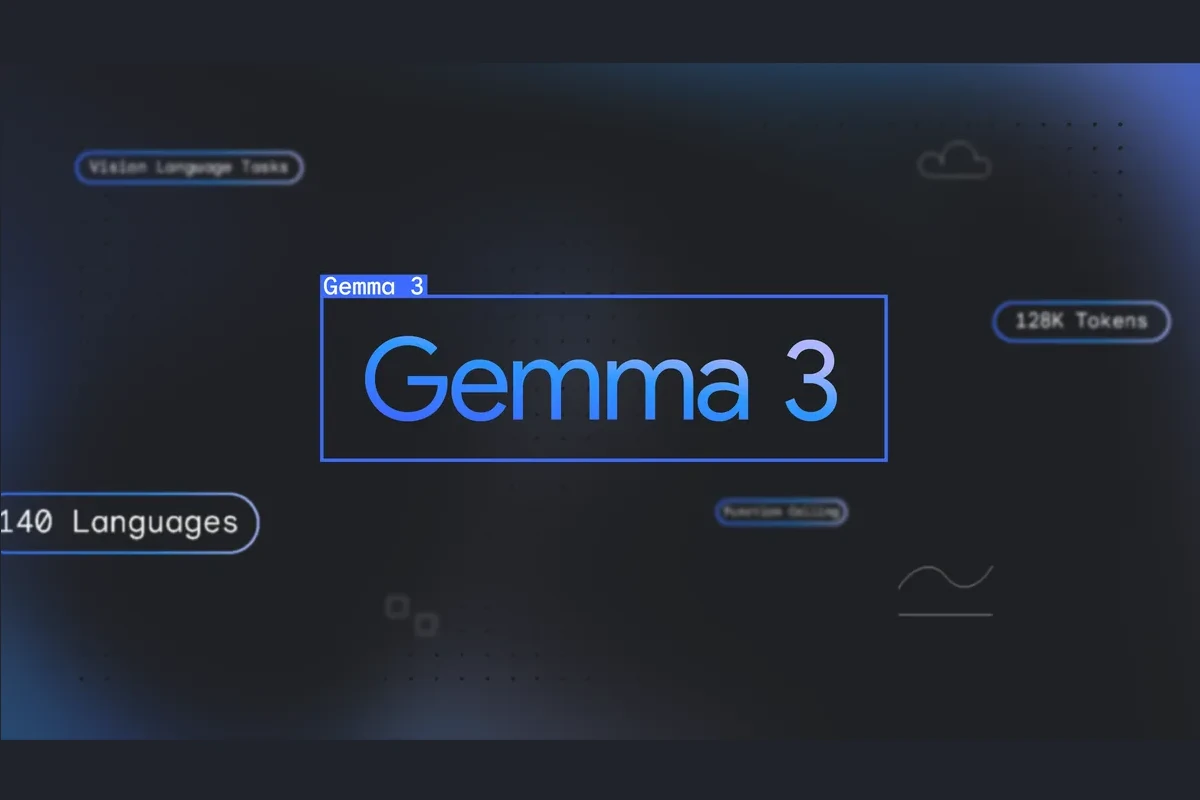
Google’s Gemma models represent a significant step in making powerful artificial intelligence more accessible, transparent, and responsible. Introduced by Google DeepMind, Gemma is a family of open-weight large language models (LLMs) designed to help developers, researchers, and organizations build AI applications while maintaining strong safety and performance standards.
Google Gemma 3: Advancing Open and Responsible AI
Gemma 3 builds on the success of earlier Gemma releases, introducing notable improvements in reasoning, efficiency, and safety while remaining true to Google’s open‑weight philosophy. Designed for modern AI workloads, Gemma 3 targets developers who need stronger performance without sacrificing transparency or responsible AI practices.
Improved Reasoning and Language Understanding
Gemma 3 delivers enhanced reasoning capabilities, producing more coherent, context‑aware, and accurate responses across complex prompts. This makes it better suited for tasks such as multi‑step problem solving, detailed explanations, and advanced conversational applications.
Greater Efficiency and Scalability
With architectural optimizations and refined training techniques, Gemma 3 achieves higher performance per parameter. These improvements allow it to run more efficiently on both cloud infrastructure and local hardware, helping teams scale applications while controlling computational costs.
Expanded Multilingual Support
Gemma 3 improves multilingual comprehension and generation, enabling more natural interactions across a wider range of languages. This makes the model particularly valuable for global products and region‑specific AI solutions.
Enhanced Safety and Alignment
Continuing Google’s emphasis on responsible AI, Gemma 3 incorporates updated safety evaluations and alignment techniques. The model is designed to reduce harmful or biased outputs while remaining flexible enough for responsible fine‑tuning and customization.
Use Cases
Gemma 3 is well‑suited for:
- Advanced chat and assistant applications
- Knowledge‑intensive Q&A systems
- Content generation and editing workflows
- Research, education, and prototyping
Gemma 3 Summary
Gemma 3 represents a meaningful evolution of the Gemma family, offering stronger reasoning, better efficiency, and improved multilingual support. For developers seeking an open‑weight model that balances capability with responsibility, Gemma 3 provides a powerful and forward‑looking foundation.
What Are Google Gemma Models?
Gemma models are lightweight, open-weight language models derived from the same research and technology that powers Google’s flagship AI systems, such as Gemini. Unlike fully closed models, Gemma provides access to model weights, allowing developers to fine-tune, customize, and deploy the models in a wide range of environments.
Gemma is designed to balance:
- High performance
- Responsible AI practices
- Accessibility for developers
Key Gemma Model Variants
Google has released several versions of Gemma to meet different computational needs:
1. Gemma 2B
- ~2 billion parameters
- Optimized for efficiency and low-resource environments
- Suitable for edge devices, research experiments, and lightweight applications
2. Gemma 7B
- ~7 billion parameters
- Stronger reasoning and language generation capabilities
- Ideal for chatbots, content generation, and developer tools
Later updates (such as Gemma 2) further improved reasoning, safety alignment, and multilingual performance, making the models more competitive with other open-source LLMs.
Core Features and Strengths
Open Weights
Gemma provides open access to model weights, giving developers:
- Greater transparency
- The ability to fine-tune for domain-specific tasks
- More control over deployment and privacy
Responsible AI Design
Google emphasizes safety throughout Gemma’s development, including:
- Training on carefully curated datasets
- Built-in safeguards against harmful outputs
- Evaluation against bias, toxicity, and misuse
This makes Gemma especially attractive for organizations that need AI systems aligned with ethical and compliance standards.
Efficiency and Performance
Gemma models are optimized to run efficiently on:
- GPUs and TPUs
- Consumer-grade hardware
- Cloud and on-device environments
This efficiency lowers the barrier to entry for smaller teams and independent developers.
Common Use Cases
Gemma models are well-suited for a wide range of applications, including:
- Conversational AI and chatbots
- Code assistance and documentation generation
- Text summarization and analysis
- Educational tools and research projects
- Prototyping AI-powered products
Because of their flexibility, Gemma models are often used as a foundation for fine-tuned, domain-specific AI systems.
Gemma vs. Other Open Models
Compared to other open-weight models like LLaMA or Mistral, Gemma stands out for:
- Strong safety-focused design
- Tight integration with Google’s AI ecosystem
- High-quality documentation and tooling
While some competitors may prioritize raw performance, Gemma aims for a balanced approach that combines usability, safety, and efficiency.
The Future of Gemma
Google positions Gemma as a growing ecosystem rather than a single release. Future updates are expected to bring:
- Improved reasoning and multilingual capabilities
- Better tooling for fine-tuning and deployment
- Deeper integration with AI development frameworks
As open and responsible AI continues to gain importance, Gemma is likely to play a central role in how developers build trustworthy AI systems.
Conclusion
Google Gemma models offer a compelling option for developers seeking open, efficient, and responsibly designed language models. By combining strong performance with transparency and safety, Gemma helps bridge the gap between cutting-edge AI research and real-world applications—making advanced AI more accessible to everyone.